
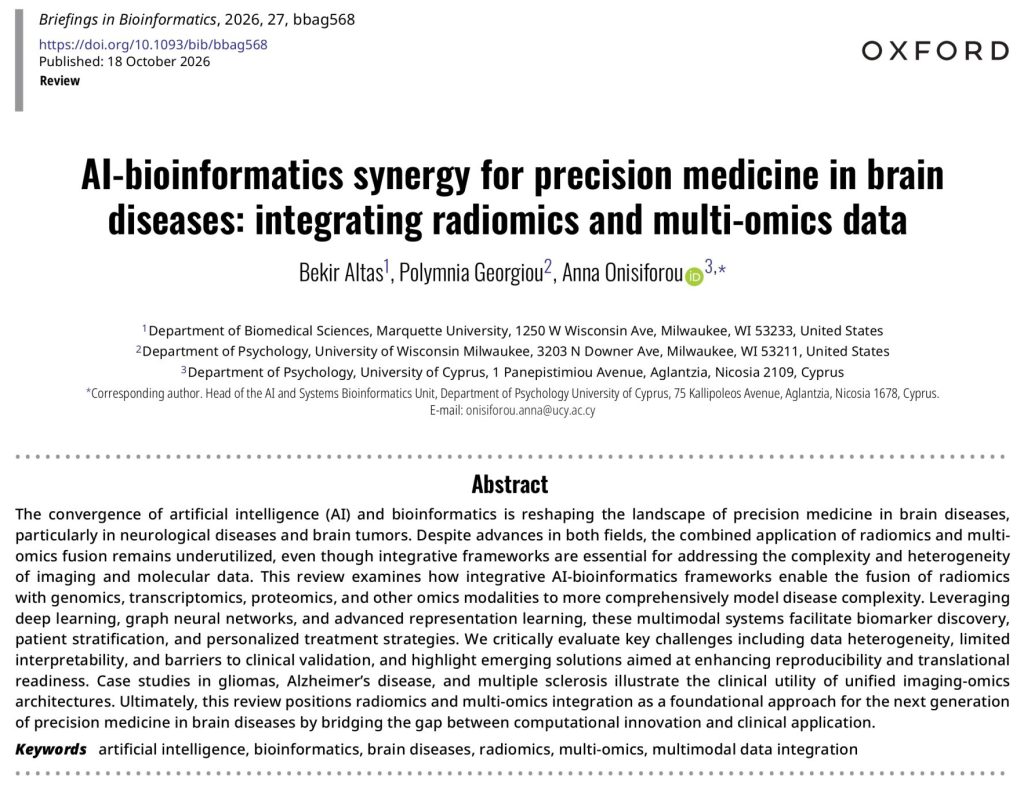
We are delighted to announce the publication of a new review article, “AI-bioinformatics synergy for precision medicine in brain diseases: integrating radiomics and multi-omics data”, in Briefings in Bioinformatics (Volume 27, Issue 5, bbag568). The work was led by Sister Annie Onisiforou, Head of the AI & Systems Bioinformatics Unit of the Translational Neuropharmacology Lab at the University of Cyprus, who is also the corresponding author. She wrote it together with our collaborators, Dr. Bekir Altas of the Department of Biomedical Sciences at Marquette University and Dr. Polymnia Georgiou of the Department of Psychology at the University of Wisconsin–Milwaukee.
Brain disorders are highly complex and vary greatly from one patient to the next, and no single type of data captures their full picture. The review looks at how AI and bioinformatics can combine radiomics, the quantitative features taken from brain imaging, with genomic, transcriptomic, proteomic and other omics data, an approach the authors argue is still underused given its potential. It surveys current methods for bringing these data types together, including deep learning, graph neural networks and representation learning. It also compares early, intermediate and late fusion strategies, and discusses generative models such as variational autoencoders, GANs and diffusion models. Case studies on gliomas, Alzheimer’s disease and multiple sclerosis show the clinical promise of combined imaging and omics models.
The review also names the main obstacles to bringing these tools into the clinic: data that differ widely in type and quality, models that are hard to interpret, and difficulties with clinical validation. It then describes emerging solutions that make results more reproducible and ready for translation. Overall, the article argues that combining radiomics with multi-omics data could become a foundation of next-generation precision medicine for brain disorders, linking computational advances to robust, interpretable and scalable clinical tools. Congratulations to Dr. Onisiforou and her co-authors on this important contribution!
The full article is available at https://doi.org/10.1093/bib/bbag568.