
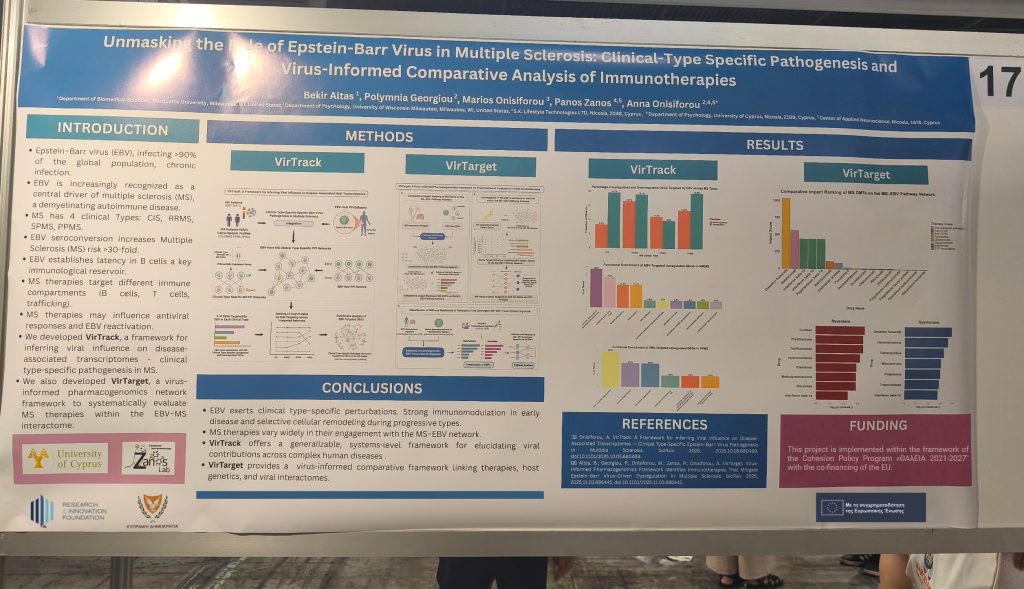
Dr. Anna Onisiforou, Head of the AI and Systems Bioinformatics Unit at our lab, presented her work at the FENS Forum 2026, Europe’s largest neuroscience congress, held on 6–10 July 2026 in Barcelona, Spain. Her poster, “Unmasking the Role of Epstein–Barr Virus in Multiple Sclerosis: Clinical-Type Specific Pathogenesis and Virus-Informed Comparative Analysis of Immunotherapies,” was co-authored with Bekir Altas (Marquette University), Polymnia Georgiou (University of Wisconsin–Milwaukee), Marios Onisiforou (S.K. Lifestyle Technologies LTD), and Panos Zanos (University of Cyprus and Center of Applied Neuroscience).
Epstein–Barr virus (EBV) infects more than 90% of the global population and establishes lifelong latency in B cells, and seroconversion raises the risk of multiple sclerosis (MS) more than 30-fold. To ask how this near-universal virus shapes disease at the molecular level, the team developed two complementary computational frameworks. VirTrack infers viral influence on disease-associated host transcriptomes, and was used here to resolve EBV-driven perturbations across the four clinical types of MS (CIS, RRMS, SPMS and PPMS). VirTarget, a virus-informed pharmacogenomics network framework, then evaluates how existing disease-modifying therapies engage the EBV–MS interactome, ranking them by their impact on the shared pathway network and classifying them as reinforcers or reversers of the convergent EBV-driven transcriptomic signature.
The analysis showed that EBV exerts clinical type–specific effects, with strong immunomodulation in early disease and more selective cellular remodeling in the progressive types, and that current MS therapies differ widely in how they engage the MS–EBV network. Beyond MS, VirTrack offers a generalizable, systems-level approach for elucidating viral contributions across complex human diseases, while VirTarget provides a comparative framework linking therapies, host genetics and viral interactomes. Both frameworks are described in preprints available on bioRxiv (doi:10.1101/2025.10.05.680499 and doi:10.1101/2025.11.03.686445). This work is implemented within the framework of the Cohesion Policy Programme “THALIA 2021-2027” with co-financing from the European Union, through the Research and Innovation Foundation of Cyprus.