
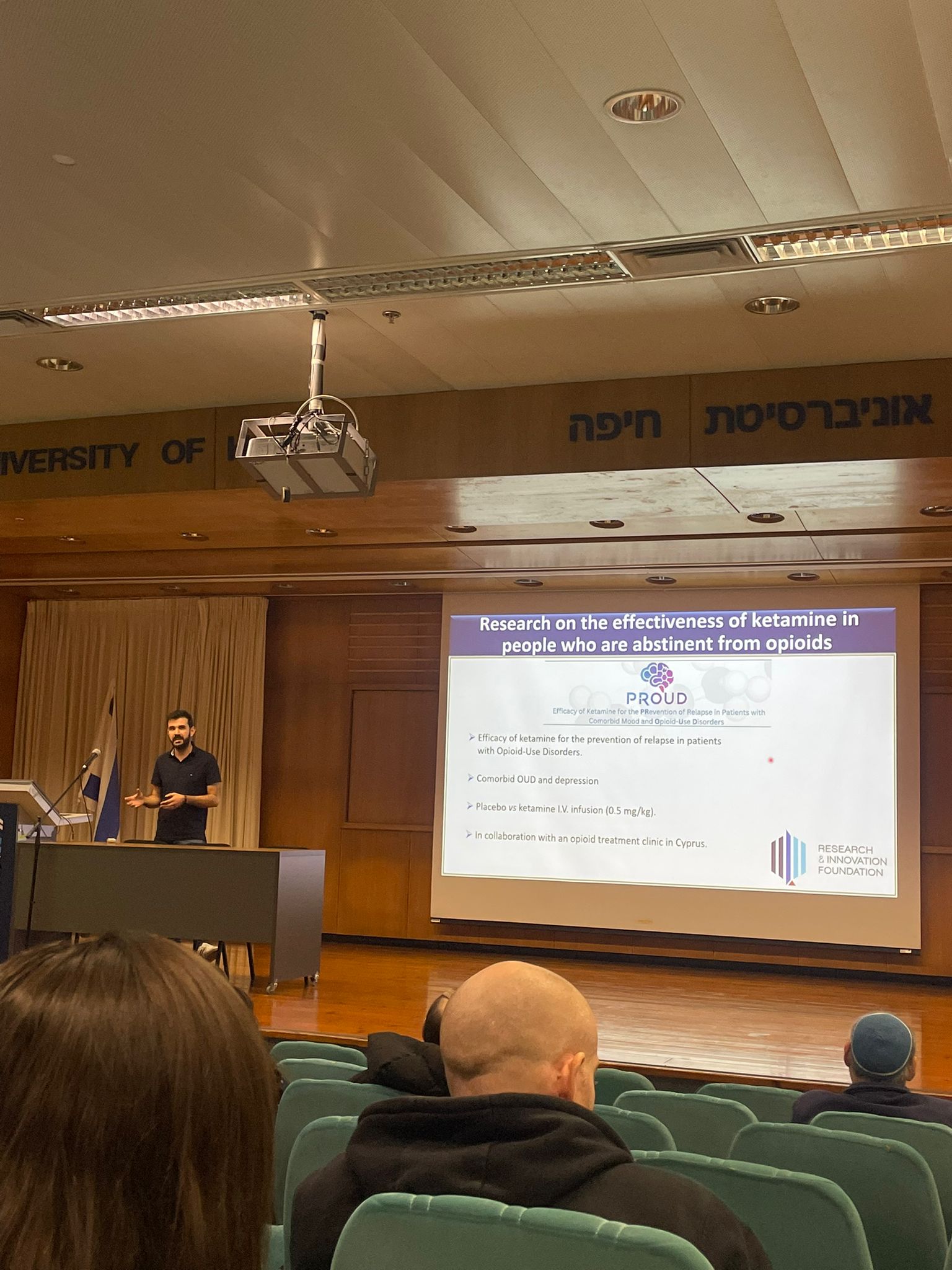
The Zanos Lab presented research on the neurobiological mechanisms underlying ketamine’s efficacy in treating both depression and substance use disorders. Dr. Zanos, Director of the Translational Neuropharmacology Lab, delivered a talk detailing the lab’s multifaceted approach to understanding how ketamine and its metabolites can address two of the most pressing public health challenges of our time: depression and opioid use disorder (OUD).
Depression and opioid use disorder represent significant global health burdens with limited effective treatment options, making the development of novel therapeutic approaches critically important. The Zanos Lab has been systematically investigating the therapeutic potential and mechanistic basis of ketamine and its metabolites using an integrative research strategy that combines behavioral, electrophysiological, and molecular approaches in preclinical models. Through extensive studies in mice, the lab has uncovered a surprising and paradigm-shifting finding: contrary to the prevailing view that ketamine works primarily through NMDA receptor blockade, the research demonstrates that NMDA receptor activation, rather than inhibition, is actually essential for its rapid antidepressant effects. The lab’s work has revealed that ketamine exhibits an inverted U-shaped dose-response relationship, and its antidepressant-like properties, hippocampal AMPA receptor upregulation, and metaplasticity induction are abolished when NMDA receptors are blocked prior to ketamine administration. This discovery extends to ketamine’s key metabolite, (2R,6R)-hydroxynorketamine (HNK), and other rapid-acting antidepressants, all of which require NMDA receptor signaling for their therapeutic actions. Importantly, the research has identified the GluN2A subunit of the NMDA receptor as being both necessary and sufficient for mediating these antidepressant effects, providing a specific molecular target for future therapeutic development.
Building on these mechanistic insights, the Zanos Lab has extended its preclinical investigations to opioid use disorder, demonstrating that (2R,6R)-HNK shows promise in addressing multiple aspects of this devastating condition. In preclinical OUD models, (2R,6R)-HNK effectively countered morphine conditioning in stress-vulnerable mice, prevented withdrawal symptoms, and alleviated anhedonia, anxiety, and cognitive deficits that emerge during protracted abstinence. Perhaps most significantly for long-term recovery outcomes, (2R,6R)-HNK enhanced the extinction of opioid conditioning, blocked stress-triggered relapse, and reduced subsequent opioid consumption. These therapeutic effects appear to be mediated, at least in part, by the compound’s ability to restore disrupted cortical high-frequency EEG oscillations that are characteristic of the addicted brain state. The preclinical findings reveal a convergent therapeutic mechanism whereby (2R,6R)-HNK promotes GluN2A-NMDAR-dependent synaptic plasticity to provide rapid antidepressant effects while simultaneously addressing the negative affective states and relapse vulnerability that characterize opioid use disorder.
Translating these promising preclinical findings to human populations represents the critical next step in developing ketamine-based therapies for opioid use disorder. The Zanos Lab is currently conducting the PROUD study (Prevention of Relapse in Opioid Use Disorder), a Phase II randomized, double-blind, placebo-controlled clinical trial examining ketamine’s efficacy in patients with opioid use disorder who are undergoing opioid substitution treatment. This human study, funded by the Research and Innovation Foundation of Cyprus is investigating whether a two-week regimen of subanesthetic doses of ketamine (0.5 mg/kg) can improve treatment retention, reverse comorbid negative affective behaviors including depression and anhedonia, and prolong abstinence in patients receiving buprenorphine/naloxone maintenance therapy. The study enrolls 60 adults aged 18-65 who meet criteria for moderate-to-severe opioid use disorder and are experiencing depressive symptoms. Beyond assessing clinical outcomes, the PROUD study is also examining novel biomarkers that may predict vulnerability to relapse, including emotion regulation ability measured through heart rate variability, stress response biomarkers such as cortisol and catecholamines, and changes in neural activity measured via EEG spectral analysis. Patients are followed for nine months after their last ketamine infusion to assess long-term effects on relapse prevention. This comprehensive approach aims to not only establish ketamine’s clinical efficacy but also to identify predictive markers that could personalize treatment strategies for individuals at highest risk of relapse during the challenging period of protracted abstinence.