
Head of the AI & Systems Bioinformatics Unit

Dr. Anna Onisiforou, BA, BSc, MSc, MSc, Ph.D.
Dr. Onisiforou holds a B.Sc. (Hons) in Natural Sciences with direction in Biology and Chemistry, a M.Sc. in Medicinal Chemistry, and a Ph.D. in Neuroscience. She also holds a B.A. (Hons) in Accounting and Finance and a M.Sc. in Finance and Financial Law.
Dr. Onisiforou completed her Ph.D. in Neuroscience, at The Cyprus Institute of Neurology & Genetics, hosted in the Bioinformatics Department, from 2018 to 2022. During her doctoral research, she conceptualized and developed systems bioinformatics approaches to investigate the interplay between viral infections and host biological processes, particularly in the context of neurodegenerative diseases. Her work introduced network-based methodologies integrating virus–host protein interactions, molecular mimicry, and microbiota–virus interactions to explore how pathogenic mechanisms may contribute to neurological and immune-related disorders
Her research established computational frameworks for studying pathogen-host interactions and their potential role in complex diseases, including neurodegenerative, autoimmune, and neuropsychiatric conditions.
Dr. Onisiforou’s achievements extend beyond her Ph.D. studies. Since 2023, she has served as Senior Scientist and Head of the AI & Systems Bioinformatics Unit, which she established within the Translational Neuropharmacology Laboratory at the University of Cyprus, advancing research at the intersection of computational and experimental neuroscience.
She is currently the Principal Investigator of the ImmUnoForecastMS project, funded by the Research and Innovation Foundation of Cyprus, which integrates artificial intelligence, computational modeling, and experimental approaches to map Epstein–Barr virus–induced immune dysregulation in Multiple Sclerosis and identify precision drug repurposing strategies and personalized therapeutic interventions. She is also Co-Principal Investigator of the ALZ-RISK project, funded by the Infectious Diseases Society of America (IDSA), investigating sex-specific viral mechanisms contributing to Alzheimer’s disease risk. In addition, she serves as co-investigator and co-applicant on multiple interdisciplinary research grants combining computational and experimental approaches to study brain disorders, including neurodegenerative and neuropsychiatric conditions, as well as systems pharmacology and therapeutic discovery.
Research Highlights
Predictive Network Pharmacology Model Anticipated the Limited Efficacy of Ozempic (Semaglutide) in Alzheimer’s Disease Before Clinical Trial Results
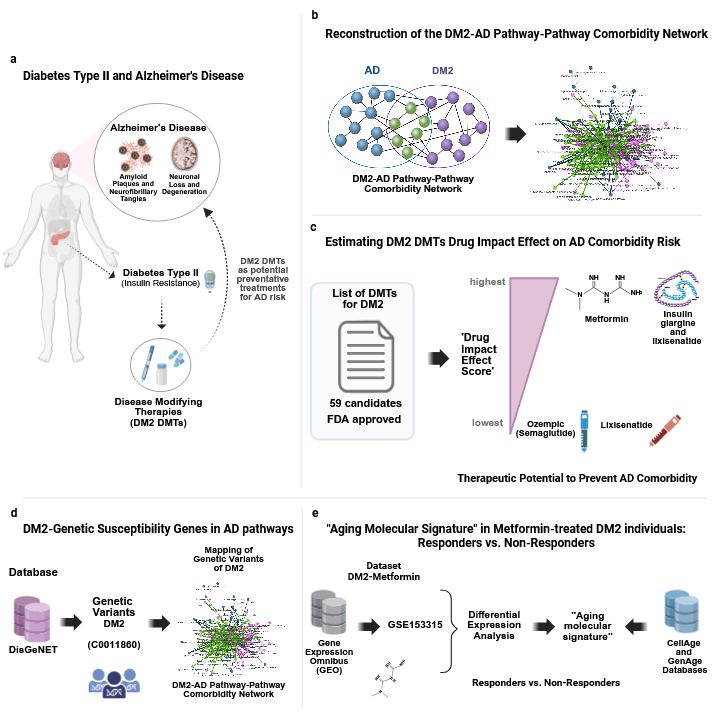 A recent study led by Dr. Onisiforou demonstrated how systems bioinformatics modeling can anticipate clinical trial outcomes before results become available. In work first released as a preprint in March 2025 and later published in Communications Medicine (Nature Portfolio), a computational network pharmacology model developed by Dr. Onisiforou and colleagues predicted that semaglutide would have limited therapeutic impact in Alzheimer’s disease (AD), ranking it among the lowest-impact diabetes therapies for AD prevention due to minimal engagement with core neurodegenerative pathways. This prediction was made months before the results of the EVOKE and EVOKE+ Phase III clinical trials were publicly reported in October and November 2025, which later confirmed that semaglutide did not slow cognitive or clinical decline in patients with AD. These findings illustrate how systems bioinformatics can help evaluate therapeutic hypotheses early and guide drug development decisions before costly clinical trials are completed.
Preprint: https://www.biorxiv.org/content/10.1101/2025.03.14.643306v1.abstract
Published article: https://www.nature.com/articles/s43856-026-01471-3
Recent Computational Frameworks Developed by the Unit
VirTrack — Mapping Viral Dynamics Across Disease Stages
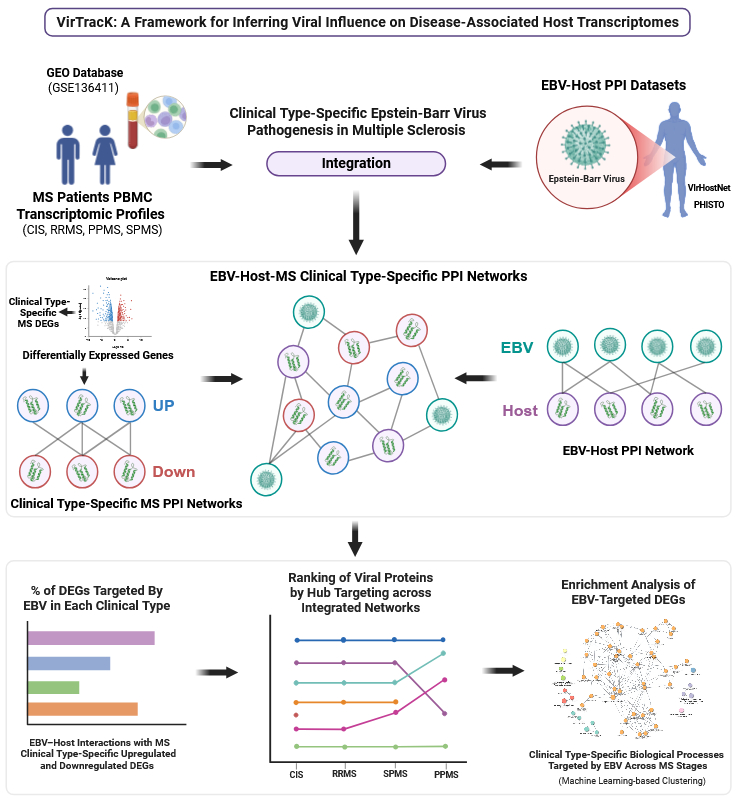 VirTrack is a systems bioinformatics framework developed by Dr. Anna Onisiforou and published as a preprint in October 2025. The framework is designed to infer the influence of viral infections on host molecular pathways by integrating virus–host protein–protein interaction (PPI) networks with disease-specific transcriptomic data. Unlike traditional static network approaches, VirTrack enables a disease-stage–resolved analysis of how viral proteins perturb host biological processes. In its primary application, VirTrack was used to investigate the role of Epstein–Barr virus (EBV) across different clinical types of Multiple Sclerosis (MS), revealing stage-dependent patterns of viral influence on host molecular networks. By identifying viral–host interactions and pathways associated with distinct disease stages, the framework provides a computational strategy for stage-tailored therapeutic targeting. VirTrack supports the development of precision antiviral and immunomodulatory strategies that account for evolving virus–host dynamics throughout disease progression. While initially applied to Multiple Sclerosis, the framework is designed to be generalizable for investigating viral contributions to a broad range of complex human diseases.
Preprint: https://www.biorxiv.org/content/10.1101/2025.11.03.686445v1.abstract
VirTarget — Pioneering Virus-Informed Pharmacogenomics for MS
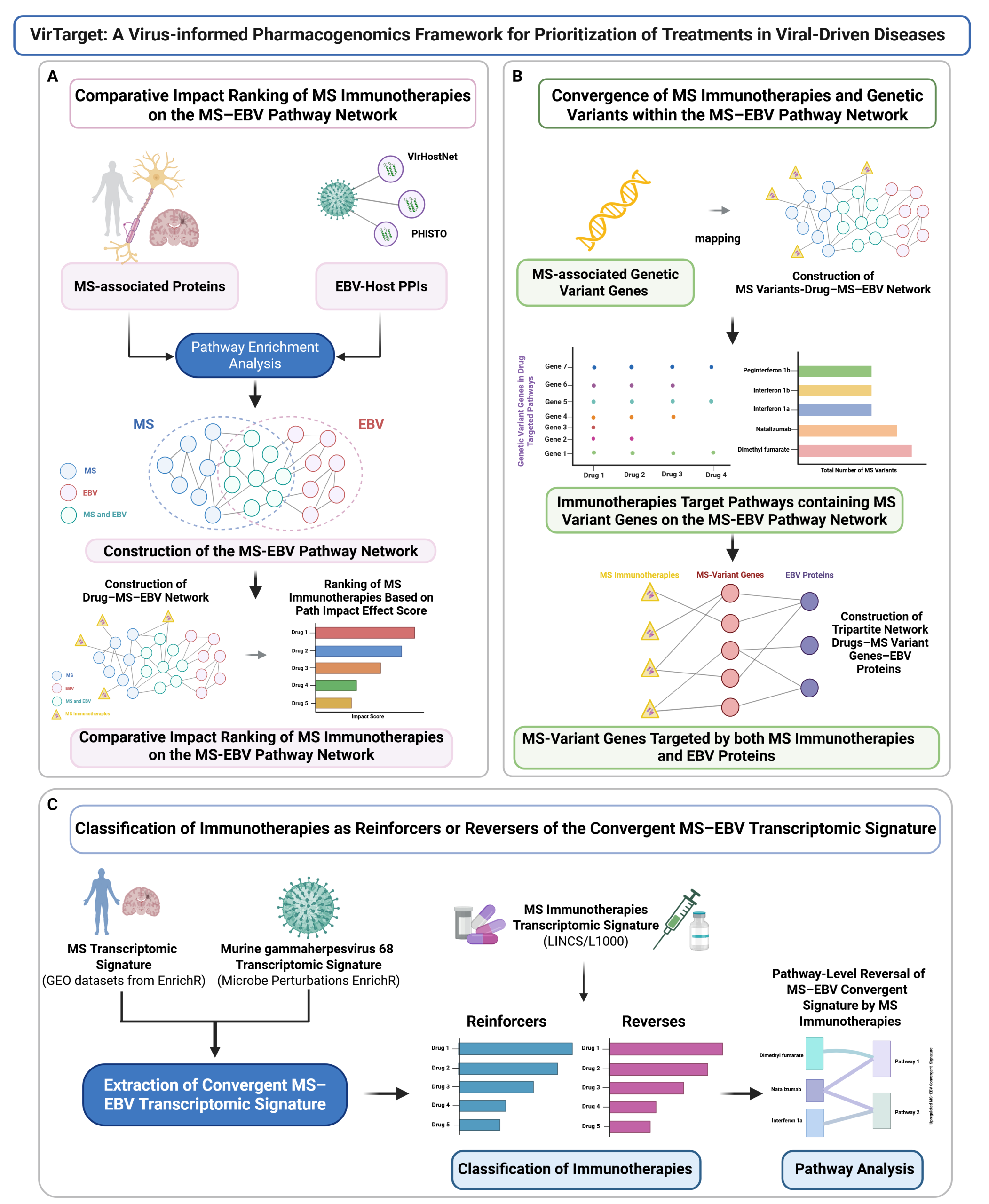 VirTarget is a virus-informed pharmacogenomics framework developed by Dr. Anna Onisiforou and colleagues from the USA and published as a preprint in 2025. The framework evaluates how MS immunotherapies interact with EBV–driven disease mechanisms by integrating EBV–host protein interaction networks, MS genetic susceptibility loci, and drug-induced transcriptomic responses. VirTarget addresses a central challenge in MS treatment, the “immunosuppression paradox”, where therapies are selected for immune suppression without considering their effects on viral biology. By classifying therapies as “reversers” (counteracting EBV-driven dysregulation) or “reinforcers” (potentially supporting viral pathways), the framework reveals how different drugs engage with virus-associated molecular networks. By identifying therapies that most effectively counteract EBV-related dysregulation, VirTarget moves MS therapy beyond a one-size-fits-all immunosuppression model toward virus-informed precision medicine, providing a roadmap for selecting treatments based on a patient’s viral and genetic profile and guiding the development of future immunotherapies that suppress disease without giving the underlying virus a biological advantage.
Other members of the Unit

Dr. Eleftheria Charalambous, BSc, MSc, Ph.D.
Josefina Ahmed
Team Members (more details in the Team Members section)
Connect with us


