
We are proud to share that Dr. Alexios Panoutsopoulos, postdoctoral researcher in the Zanos Lab, presented his work at the FENS Forum 2026, held 6-10 July in Barcelona, Spain. The FENS Forum is Europe’s largest neuroscience meeting, and this year’s edition was the biggest yet, drawing more than 8,000 attendees from across the world. The research was carried out as part of his ONISILOS fellowship, the University of Cyprus’s international postdoctoral programme co-funded by the European Union’s Marie Skłodowska-Curie Actions (Horizon 2020) and UCY.
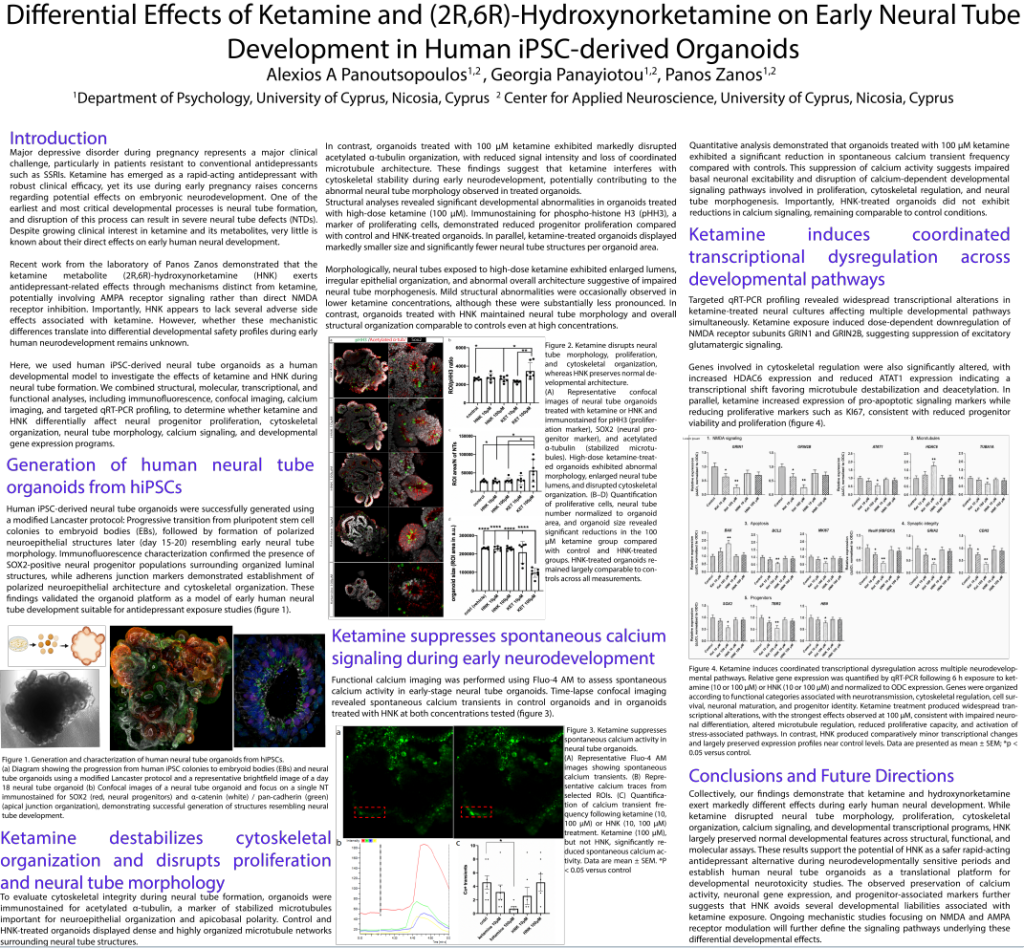
The study used human neural tube organoids generated from human induced pluripotent stem cells (hiPSCs) as a model of early human neurodevelopment, to ask how ketamine and its metabolite hydroxynorketamine (HNK) affect the developing nervous system. Across a range of concentrations, ketamine destabilized cytoskeletal organization and disrupted progenitor proliferation and neural tube morphology, altering markers such as pHH3, acetylated α-tubulin and Sox2 and reducing organoid size at the higher dose. Ketamine also suppressed spontaneous calcium signaling during this early developmental window, dampening the calcium transients that are important for healthy neurodevelopment. At the transcriptional level, it produced coordinated dysregulation across multiple developmental pathways — including NMDA-receptor signaling (GRIN1, GRIN2B), microtubule regulation (ATAT1, HDAC6, TUBA1A), apoptosis (BAX, BCL2, MKI67), synaptic integrity (NeuN/RBFOX3, GRIA2, CDH2) and progenitor identity (SOX2, TBR2, HB9). Notably, HNK showed a milder profile than ketamine across these readouts, pointing to differences in how the two compounds act on the developing brain.
Together, the findings highlight the value of hiPSC-derived neural tube organoids for probing how anaesthetic and psychoactive compounds influence early brain development, and set the stage for future work dissecting the mechanisms and long-term consequences of these effects.