
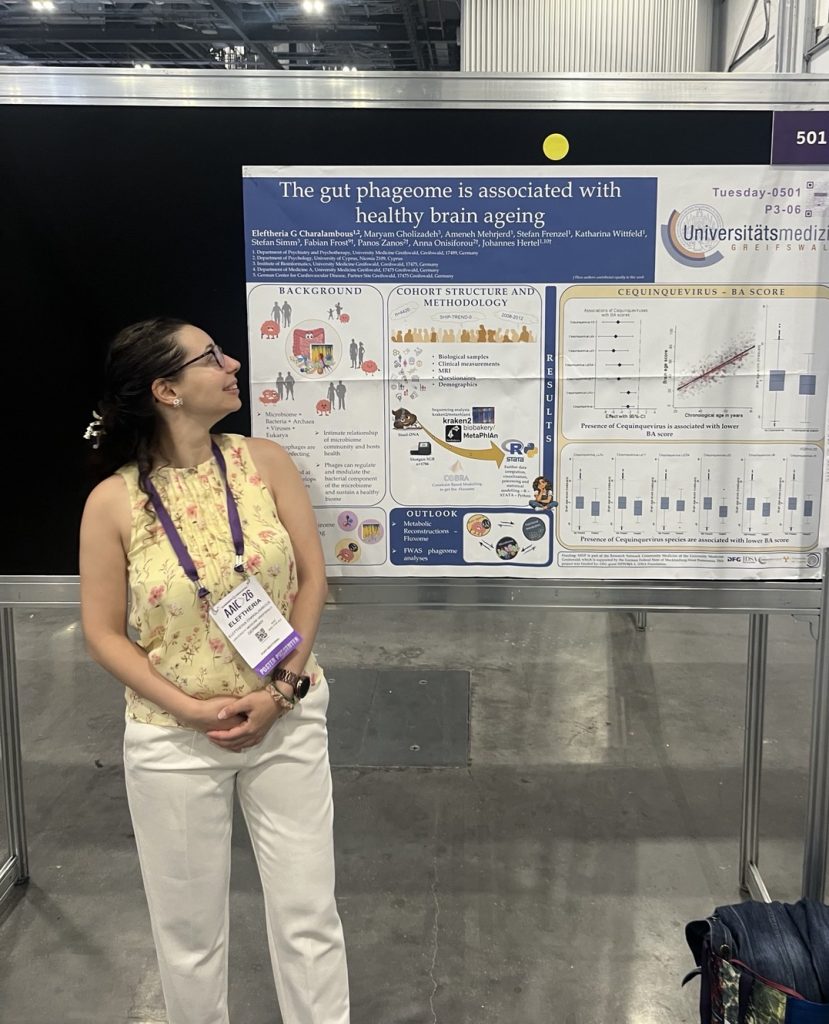
We are delighted to share that Dr. Eleftheria G. Charalambous, member of the AI & Systems Bioinformatics Unit (Cyprus), led by Dr. Anna Onisiforou, presented our findings at the Alzheimer’s Association International Conference (AAIC) 2026, held 12-15 July in London, United Kingdom. AAIC is the world’s largest meeting dedicated to advancing Alzheimer’s disease and dementia science, this year bringing together more than 13,000 researchers and clinicians from over 110 countries. Dr. Charalambous presented our poster, “The gut phageome is associated with healthy brain ageing”.
The work explores an often-overlooked part of the gut microbiome: the phageome, the community of bacteriophages that infect gut bacteria and help regulate and sustain a healthy microbial ecosystem across the lifespan. Using the population-based SHIP-TREND-0 cohort (n = 4,420), we combined stool-DNA shotgun metagenomic sequencing (Kraken2 / MetaPhlAn4; species-level analysis in n = 1,786 participants) with MRI-derived brain age scores, clinical data and constraint-based metabolic modelling (COBRA), integrated across R, STATA and Python. Our central finding is that the presence of Cequinquevirus, and of individual Cequinquevirus species, is associated with a lower brain age score, indicating a brain that appears younger than expected for a person’s chronological age, and pointing to a link between the gut phageome and healthier brain ageing.
This project is a collaboration between the University of Cyprus (Department of Psychology) and University Medicine Greifswald (Department of Psychiatry and Psychotherapy, and Institute of Bioinformatics), together with partners at the German Center for Cardiovascular Disease.