
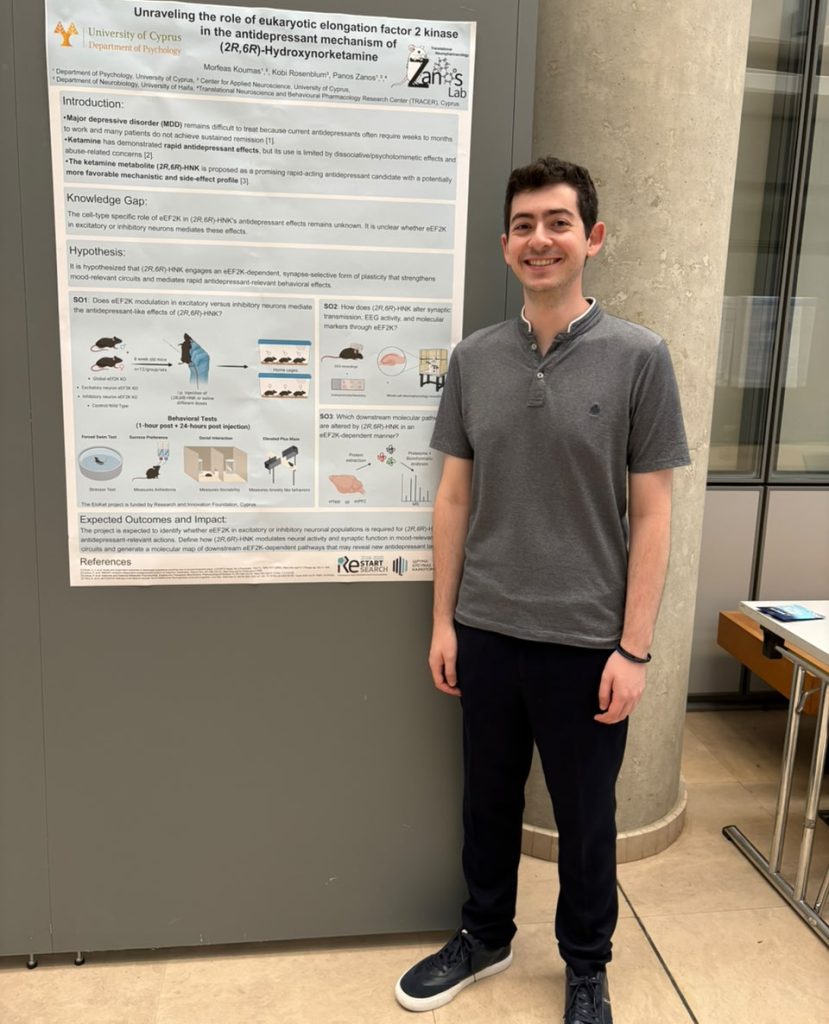
We are proud to share that our Ph.D., Mr. Morfeas Koumas, recently presented his research as a poster at 2026 Department of Psychology Academic Conference at the University of Cyprus, showcasing work conducted as part of the EloKet project of our lab.
His study, titled “Unraveling the Role of Eukaryotic Elongation Factor 2 Kinase in the Antidepressant Mechanism of (2R,6R)-Hydroxynorketamine,” investigates the cell-type specific role of eukaryotic elongation factor 2 kinase (eEF2K) in mediating the antidepressant effects of (2R,6R)-HNK — a promising metabolite of ketamine with a potentially more favorable mechanistic and side-effect profile compared to its parent compound. While ketamine has demonstrated rapid antidepressant effects, its clinical use remains limited by dissociative and abuse-related concerns. (2R,6R)-HNK has emerged as a candidate that may circumvent these limitations, yet the molecular and circuit-level mechanisms underlying its action remain poorly understood.
The study is built around three specific objectives: first, to determine whether eEF2K modulation in excitatory versus inhibitory neurons mediates the antidepressant-like effects of (2R,6R)-HNK; second, to examine how (2R,6R)-HNK alters synaptic transmission, EEG activity, and molecular markers through eEF2K; and third, to identify which downstream molecular pathways are altered by (2R,6R)-HNK in an eEF2K-dependent manner. To address these questions, the research employs global and cell-type specific eEF2K knockout mouse models, alongside a battery of behavioral tests — including the Forced Swim Test, Sucrose Preference, Social Interaction, and Elevated Plus Maze — conducted 1 hour and 24 hours post-injection. Proteomic and bioinformatic analyses of the hippocampus and prefrontal cortex further complement the neurobiological investigations.
The project is expected to identify whether eEF2K in excitatory or inhibitory neuronal populations is required for (2R,6R)-HNK’s antidepressant actions, define how (2R,6R)-HNK modulates neural activity and synaptic function in mood-relevant circuits, and generate a molecular map of downstream eEF2K-dependent pathways that may reveal new antidepressant targets.