
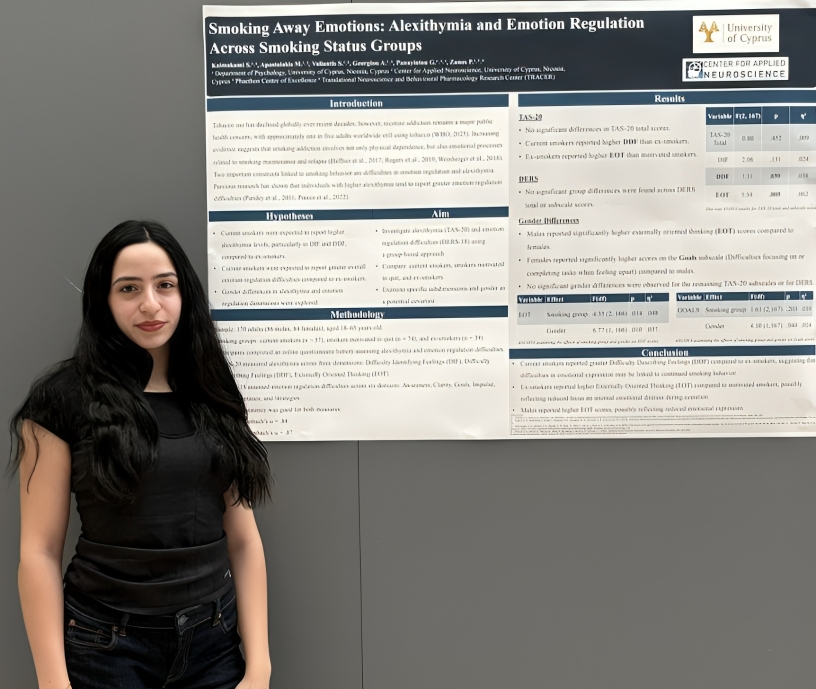
We are proud to share that our research assistant, Ms. Styliani Kaimakkami, recently presented her research poster at the 2026 Department of Psychology Academic Conference at the University of Cyprus, showcasing work conducted as part of the BioNic project of our lab.
Her study, titled “Smoking Away Emotions: Alexithymia and Emotion Regulation Across Smoking Status Groups,” investigated the relationship between alexithymia (i.e., a trait characterized by difficulties identifying and describing emotion) and emotion regulation difficulties across three groups: current smokers, individuals motivated to quit, and ex-smokers. Using a group-based approach with a community sample of 170 adults aged 18–45, the research drew on two validated instruments: the Toronto Alexithymia Scale (TAS-20) and the Difficulties in Emotion Regulation Scale (DERS-16).
Among the key findings, current smokers reported higher Difficulty Describing Feelings (DDF) compared to ex-smokers, suggesting that difficulties in emotional expression may be linked to continued smoking behavior. Ex-smokers, on the other hand, reported higher Externally Oriented Thinking (EOT) compared to smokers motivated to quit, possibly reflecting reduced focus on internal emotional distress following cessation. Gender differences were also observed: males reported significantly higher EOT scores overall, while females showed higher scores on the Goals subscale of the DERS, indicating greater difficulty completing tasks when feeling emotionally dysregulated. No significant group differences were found for DERS total or subscale scores, underscoring the importance of examining specific facets of alexithymia and emotion regulation rather than global measures only.
These findings point to emotion regulation as a meaningful target for smoking cessation interventions, and contribute to a growing body of evidence on the psychological mechanisms underlying smoking behavior.