
Novel Computational Framework Reveals EBV’s Role in Multiple Sclerosis Presented at 15th International Conference of the Center for Applied Neuroscience
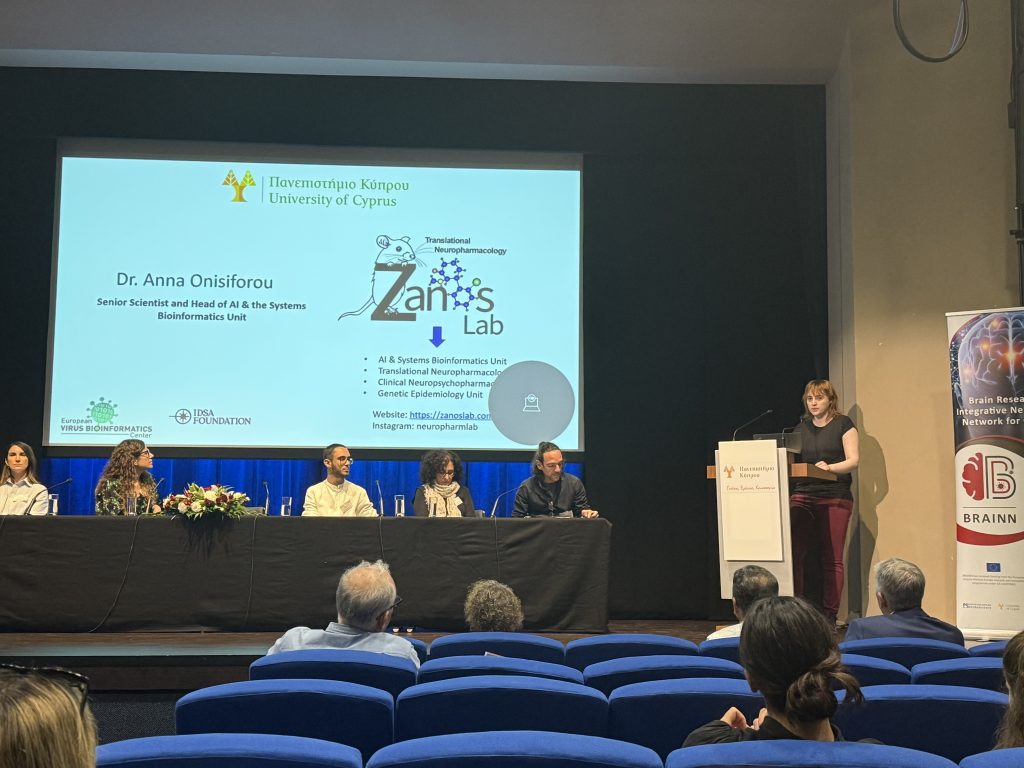
We are proud to announce that our Senior Researcher Dr. Anna Onisiforou presented groundbreaking research on the role of Epstein–Barr virus (EBV) in Multiple Sclerosis (MS) at the 15th International Conference of the Center of Applied Neuroscience, held at the University of Cyprus.
Dr. Onisiforou’s presentation introduced VirTrack, an innovative computational framework developed in our laboratory that integrates experimentally validated EBV–host protein–protein interactions with clinical type–specific peripheral blood transcriptomes. This novel approach enables systematic investigation of how EBV influences different MS clinical types, including Clinically Isolated Syndrome (CIS), Relapsing Remitting MS (RRMS), Secondary Progressive MS (SPMS), and Primary Progressive MS (PPMS).
The research reveals that EBV engagement is highly clinical type–dependent. In early MS stages (CIS and RRMS), EBV targets approximately 13–18% of dysregulated genes, enriching for B-cell–related processes, Toll-like receptor signaling, and infection-like inflammatory pathways, while suppressing antiviral and NF-κB responses. Progressive clinical types showed fewer viral connections but exhibited distinct mechanistic shifts: SPMS was characterized by suppression of vascular and cardiac repair–associated pathways, whereas PPMS was dominated by upregulation of vacuolar and lysosomal remodeling processes.
The analysis identified a stable core of influential EBV proteins, with EBNA-LP consistently ranking highest, alongside BZLF1, BVLF1, LMP2, and BDLF4. These findings suggest that EBV shapes MS through dynamic, clinical type–specific perturbations, driving strong immunomodulation in early disease and selective cellular remodeling during progressive stages.
This work has important implications for stage-tailored therapeutic targeting, supporting the potential for early EBV-directed interventions and revealing possible links to vascular comorbidity in progressive MS types. Beyond MS, VirTrack offers a generalizable, systems-level framework for elucidating viral contributions across complex human diseases.